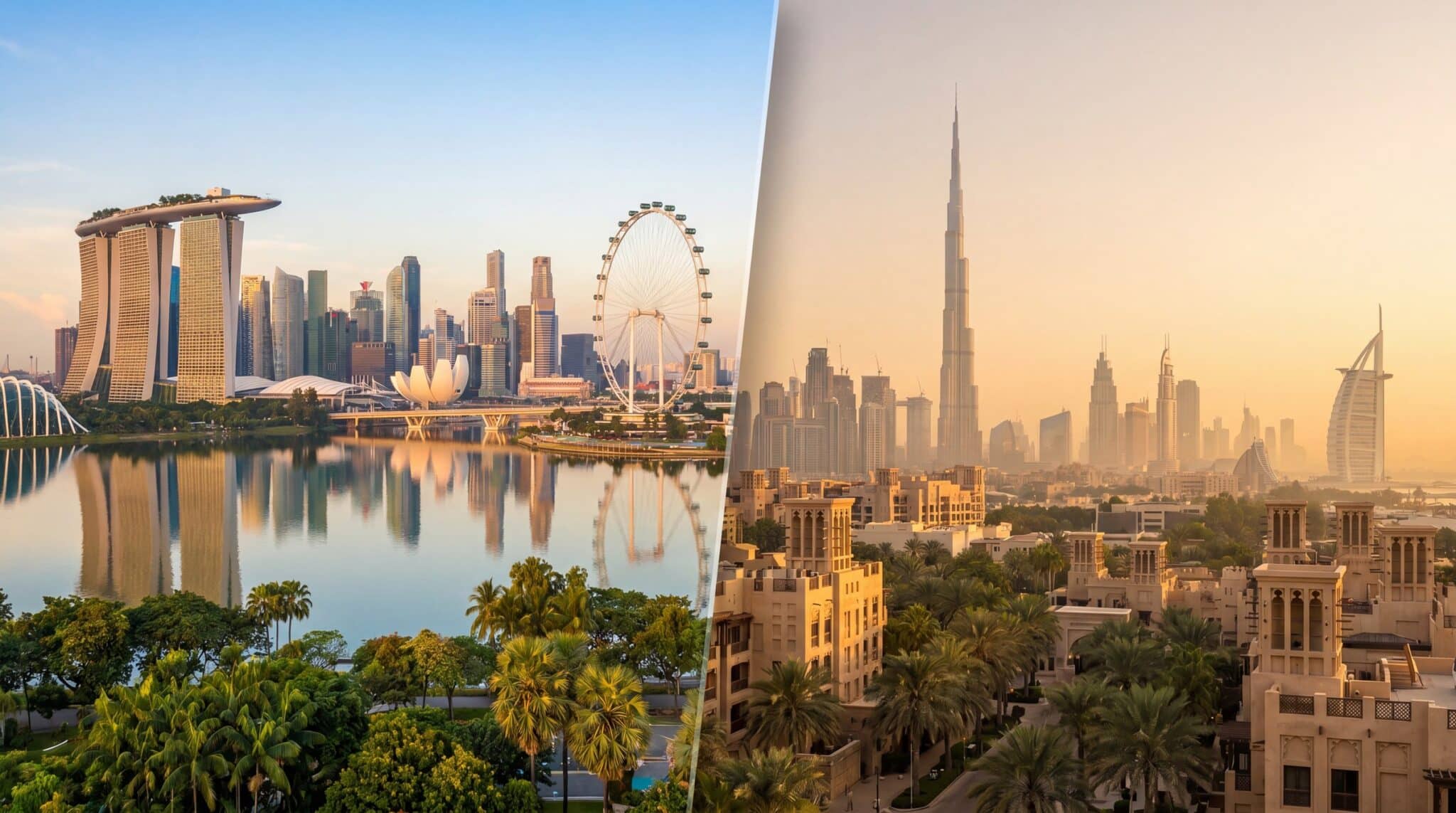
Family Offices Move East: UAE or Singapore — Which Is the 2026 Wealth Safe Harbor?
In 2026, the location logic of the family office is undergoing a fundamental shift.
In the past, this question was usually reduced to a comparison of tax rates: where is corporate income tax lower? Where is there no capital gains tax? Where is overseas income tax-exempt? But by 2026, a choice based purely on tax rates has become a dangerous oversimplification.
Because a family office is not a tax-avoidance shell. It is the control room, decision-making nerve center, and operating platform for an ultra-high-net-worth family's wealth. The core functions it must carry include: investment decisions and execution across multiple asset classes, maintaining banking and credit relationships, education and life arrangements for the next generation, implementation of the family governance structure, asset mobilization and business continuity under extreme circumstances, and the legal architecture for intergenerational succession.
Singapore and the UAE (mainly Dubai and Abu Dhabi) are the two hottest siting hubs for Asian and Middle Eastern family offices in 2026. But what they represent is not a "better or worse" choice; rather, they are two entirely different philosophies of wealth infrastructure.
Global Wealth Moves East: Why Asia and the Middle East
Traditional Western financial centers—Switzerland, London, New York—remain important hubs for global wealth management. But high-net-worth families, especially wealth creators from Asia, the Middle East, and emerging markets, are reassessing how well these traditional centers fit their needs.
The drivers come from multiple dimensions:
Tax pressure. Tax burdens on high-net-worth individuals continue to rise across many Western countries, with ongoing debate over wealth taxes, inheritance taxes, and surtaxes. For some families, maintaining the tax efficiency of a family office in a Western hub is becoming difficult.
Political and geopolitical uncertainty. The sanctions environment after the Russia-Ukraine conflict, the policy vacillations of some countries, and the tightening scrutiny by traditional hubs of wealth from particular sources have led some families to worry about the safety of their assets within the traditional system.
Tightening bank compliance. Traditional private banks are imposing ever-stricter KYC and EDD requirements on emerging-market clients, and the difficulty and maintenance cost of opening accounts keep rising. Some families are finding that their banking relationships in Switzerland or London are shifting from "priority client" to "high-risk client."
The rise of new-economy wealth. Wealth created by crypto assets, tech entrepreneurship, and family-business IPOs differs from traditional old money in its holding structures and liquidation paths. These wealth creators need family-office infrastructure that is more flexible, more modern, and friendlier to emerging asset classes.
Against this backdrop, Singapore and the UAE — with their strategic geographic positions, modern financial ecosystems, and policy openness — have become the two leading alternatives.
Singapore: A Compliance-Driven Wealth Fortress
Singapore's family-office ecosystem has matured rapidly over the past five years. Its appeal comes not only from tax incentives but from an entire system of regulatory credibility and financial infrastructure.
Regulatory framework and tax incentives. Singapore does not simply treat a family office as an ordinary company; a relatively clear set of regulatory and compliance expectations has already formed around single family offices, fund tax exemptions, anti-money-laundering review, and bank account opening. Tax-exemption schemes such as 13O, 13OA, and 13U can provide tax exemption on investment returns for qualifying fund vehicles, but their thresholds have become highly substantive: including designated investment asset size, investment professionals, local business spending, capital deployment requirements, and opening a private banking account at a MAS-licensed financial institution.
Depth of the financial ecosystem. Singapore has Asia's most mature private banking network, trust and fund services, and legal and accounting professional support. For families that value bank trust, need complex structured products, and require Asian-market investment capabilities, Singapore offers a choice with both depth and breadth.
Education and quality of life. Singapore's international-school education system, medical facilities, safe environment, and multicultural society hold a natural appeal for families that prioritize the next generation's education and family quality of life.
Regulatory reputation. Singapore's international reputation as a strong financial regulator means a family office set up there is more readily recognized by the world's major private banks and investors. This "regulatory endorsement" carries real value when international financing, co-investment, or cross-border transactions are needed.
But Singapore's thresholds are rising. In the application and subsequent review of tax-exemption schemes such as 13O/13U, MAS and related authorities are scrutinizing ever more strictly, and their tolerance for "shell" arrangements has clearly declined. Applicant families need to demonstrate genuine asset-management activity, local investment decisions, compliant operations, and ongoing local business spending. Families that merely want to set up a legal entity to "ride on" Singapore's financial reputation, without real operational intent, will find it increasingly hard to pass approval and subsequent compliance review.
Financial and intelligence linkages with China.Another structural risk often underestimated is the overly close financial and intelligence linkage between Singapore and China. Singapore and China have signed CRS Through automatic information exchange, bilateral tax treaties, and a series of mutual legal assistance arrangements, local banks are continually upgrading due diligence on Mainland Chinese PEPs (politically exposed persons), gray-background funds, and cross-border related-party transactions. For high-net-worth families with a Chinese background, the old belief that "Singapore = safe house" is being recalibrated—it remains a highly compliant financial center, but it is highly transparent precisely because its visibility to China is also extremely high. If a family's core risk stems from the identity itself needing distance from its original jurisdiction, stacking the family office, assets, and bank accounts all on this single node called Singapore is the same as concentrating all visibility in front of one mirror.
The UAE: An Agile Global Control Tower
The UAE's family-office ecosystem, particularly the frameworks of the Dubai International Financial Centre (DIFC) and the Abu Dhabi Global Market (ADGM), represents a different philosophy.
Administrative efficiency and commercial flexibility. The UAE's administrative processes are usually faster and more flexible than Singapore's. The timelines for company registration, license applications, visa processing, and account opening are shorter. For families that need to quickly establish an operating entity, launch investment activities, or manage cross-regional business, this efficiency carries real value.
A Europe-Asia-Africa hub location. Dubai's geographic position makes it a natural hub connecting Europe, Asia, and Africa. For families whose investment map spans multiple emerging markets and who need frequent cross-regional travel and transactions, the UAE's geographic advantage is hard to replace.
Openness to new-economy wealth. The UAE's acceptance of crypto assets, blockchain, Web3, and other emerging asset classes is markedly higher than that of many traditional financial centers. Both DIFC and ADGM have established dedicated rules or regulatory pathways around digital assets, fintech, and related regulated activities, allowing families holding large amounts of new-economy assets to discuss management and investment arrangements within clearer institutional boundaries.
A common-law legal framework. DIFC and ADGM adopt independent legal systems based on English common law, complete with independent courts and arbitration mechanisms. This provides families accustomed to common-law systems with a familiar legal environment and predictability.
Long-term residency arrangements. Long-term residency programs such as the UAE's golden visa provide a stable living foundation for the family office's key personnel and their families.
But the UAE is not a one-size-fits-all solution. If a family relies heavily on the deep services of traditional private banks, values investment capabilities in East Asian markets, or needs very mature trust and succession structures, Singapore still holds an edge in certain dimensions. Moreover, although the UAE's international regulatory reputation is improving, it still lags Singapore, and some extremely conservative financial institutions may scrutinize UAE entities more strictly.
A Common Misconception: Treating the UAE and Singapore as an Either/Or Choice
The consultation misconception BPROL worries about most is when a family treats the family-office location as a single-choice question of ”the UAE or Singapore.”
Mature ultra-high-net-worth families rarely concentrate all functions in a single jurisdiction. A more sensible model is to allocate by function, building a cross-regional family operating map:
SingaporeanCarrying the functions of regulated wealth management, the core trust-succession architecture, Asian-market investment, and a hub for the next generation's education and life.
UAECarrying the functions of global emerging-market investment, business control, testing the waters with new-economy assets, and cross-border capital deployment.
A third or fourth countryCarrying the functions of backup residence, tax-residency status, or a crisis landing point.
The logic of this functional allocation is to place each function in the jurisdiction best suited to it, rather than forcing all functions into a single place.
The essential question in siting a family office is not "which country is better," but "what kind of infrastructure does each of the family's functions need to be carried on." Where do the core decision-makers live? Where do the directors perform their duties? In which time zone do the bank accounts operate? Where does the investment committee meet? Where do the beneficiaries primarily spend and live? Where does the next generation receive education?In a crisis, where can the family and its core liquid assets be legally moved within 72 hours and begin operating?
Only when these questions have clear answers does family-office location-selection make sense. Otherwise, an expensively built family office is just a costly legal shell.
A Step Ahead of Family-Office Location: A Second Identity as the Family's Identity Foundation
Siting a family office is a slow decision. From mapping the core decision-makers' life trajectory, assessing the migration of banking relationships, and building the director and trustee structure, to meeting the MAS 13O/13U assets-under-management threshold, setting up in DIFC or ADGM, license approval, office and staffing arrangements, and subsequent compliance implementation—the entire sequence often cannot be completed in a few weeks, and for complex families may stretch beyond a year, while depending heavily on numerous supporting decisions the family itself makes along the way.
But the external environment a family faces often will not wait. Exchange-rate swings, policy adjustments in the country of origin, upgraded bank KYC, tightening visa policy, sudden geopolitical events — these variables can occur at any time within the window before a family office is even established.
This raises an often-overlooked question of sequence: while weighing the UAE against Singapore over and over without reaching a decision, what a family should really move on first is often not the family office itself, but the identity arrangements of its core members.
Identity Is the Fast Variable Within Slow DecisionsThe A mature family office takes time to refine; but a second identity or long-term residency for the family's core members—depending on the chosen program and jurisdiction—can usually be completed within 6 to 24 months and does not depend on the family office's final siting conclusion. This time gap makes a second identity the piece of the puzzle most worth front-loading within the family office's decision cycle.
The real value of an identity foundation lies not in “switching passports” but in “expanding the family's lawful options.” This manifests on four levels:
First,preserving flexibility for family-office location. When the family's core members already hold a UAE golden visa, Singapore PR, long-term residency in an EU country, orCaribbean citizenshipone or more of these, then no matter whether the family office ultimately lands in Singapore or Dubai, or adopts a cross-regional functional allocation model, it will not be forced to accept a suboptimal structure because of the limitations of a single visa identity. Identity does not predetermine the family office answer, but identity determines how many cards you hold when making the family office decision.
Second,providing a compliance fulcrum for banking relationships. Modern private banks are continually increasing their granularity in KYC, tax residency declaration, and source-of-funds review. When family members hold a clear, explainable second identity or long-term residency, it can significantly lower account-opening friction and provide a more stable compliance foundation for building the account structure after the family office is established.
Third,providing a lawful landing point for crisis relocation. The "72-hour crisis test" mentioned in the previous section essentially examines whether, in a sudden situation, the family has a legal identity and foothold that can be activated immediately. If the second identity must wait until the family office is fully set up before being arranged, this test is a failing grade during the family office's build-out period.
Fourth,paving the way in advance for the next generation's education and life. Where a family office ultimately lands is often influenced by the next generation's education path; and whether the next generation can enter the target country's education system and enjoy local life amenities depends, in turn, on whether the family holds a suitable residency identity in advance. If this causal chain is run backward, the time cost is clearly magnified.
Two points warrant attention in the risk breakdown. First, a second identity is not better the more you have — each identity corresponds to filing obligations, tax linkages, and potential CRS information-exchange pathways, blindly stockpiling identities will instead create new compliance exposure. Second, identity arrangements must stay consistent with the family's overall tax-residency planning, asset-holding structure, and the future location of the family office, avoiding a situation where "identity is in country A, the family office in country B, tax residency in country C, and the bank account in country D" yet they all conflict with one another.
On the order of operations, BPROL's advice is: while launching due diligence and scheme design for the family office siting, run a parallel assessment of whether the current identity mix of the family's core members already covers the main use cases of the next 5 to 10 years. If there is a clear gap—for example, the core decision-maker has no long-term residency in any third country, the spouse and minor children lack legal identity options independent of the country of origin, or the family lacks a stable identity that can serve as a crisis foothold—then this part of the configuration should be completed before the family office siting, or at least before the family office siting is locked in.
The family office is the control tower of family wealth; the second identity is the passport of the family members. The control tower can be built slowly, but the passport must be in hand a step earlier.
Conclusion
There is no absolute superiority between the UAE and Singapore. One emphasizes rules, bank trust, and long-term succession; the other emphasizes efficiency, global connectivity, and business agility. The real standard for choosing a family office location in 2026 is not license fees, tax holidays, or registered capital, but who can more safely, legally, and smoothly carry the family's wealth control for the next decade—indeed, the next fifty years.
At the same time, what cannot be ignored is thatboth Singapore and the UAE maintain long-standing, friendly, and close bilateral relations with China— economic and trade cooperation, diplomatic coordination, and financial and judicial-intelligence linkages are all continually deepening. The compliance advantages of these two jurisdictions are real, but for families with Chinese backgrounds, they also mean extremely high transparency and visibility.
This is why we always emphasize one thing: a second identity is not an ”add-on” to the family office, but a more central succession strategy. Caribbean CBI allows you, in the CRS / CARF era, to preserve an independent tax and identity pathway for the family — letting the compliance advantages of the family office remain compliance advantages, and the family's identity options remain identity options, so that the two are no longer locked to the same set of jurisdictions.
A true wealth haven is not a single location, but a system of family operations reasonably distributed across multiple locations and mutually reinforcing.
Family-office location determines where wealth resides; a second identity determines where the family can go. The former is a slow decision, the latter an opening move — and a mismatch in the sequence of the two is often the real risk families are most likely to step on in 2026.
To learn more about identity planning and global asset positioning, you can speak withContact UsThe