

2026-03-02 | BPROL 紧急策略简报·第二篇
⚡ This article is the second briefing in the BPROL US-Iran War series. 第一篇(2026-02-28)分析了战争爆发对中国高净值人士的三重冲击:次级制裁外溢、美元体系武器化、KYC 穿透加速,并提出「底层身份—护照梯队—72 小时行动清单」三步行动框架。→ Read the first article
>
48 hours later, the situation escalated sharply—the war spread from Tehran to Dubai.
📡 At a Glance | Where Iranian Missiles Struck Within 72 Hours
On February 28, the United States and Israel launched a joint strike against Iran, killing Khamenei. Iran's retaliatory strikes were not directed at Israeli soil—but at the Middle Eastern hub that global high-net-worth individuals rely on most: the UAE.
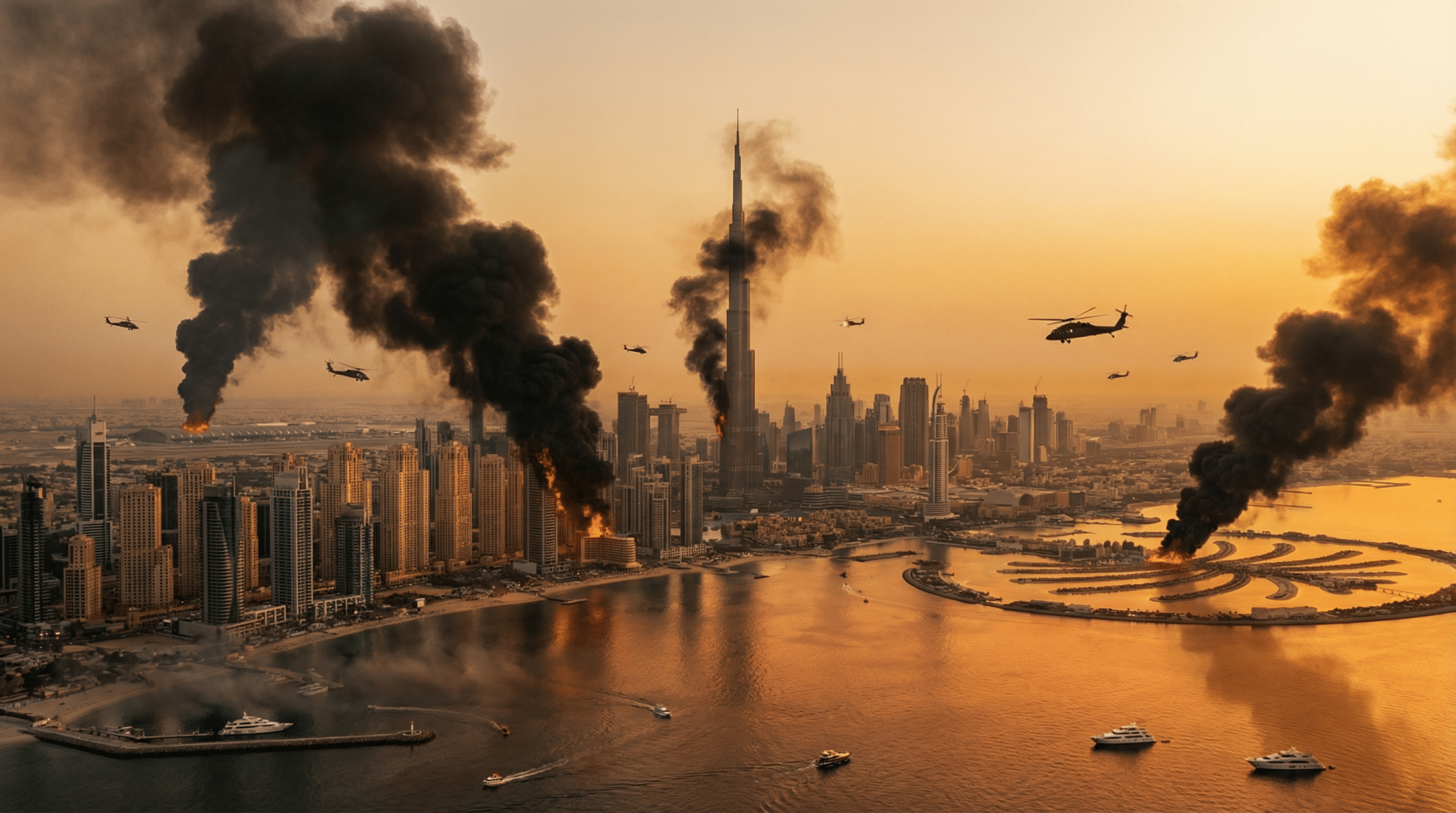
据阿联酋国防部声明(2026-03-01),伊朗向阿联酋领土发射 137 missiles and 209 drones, most of which were intercepted by air-defense systems, but the warheads that penetrated the defenses precisely struck the most critical infrastructure of Dubai and Abu Dhabi:
- Dubai International Airport(DXB): a jet bridge at one terminal was directly damaged, 4 staff members were injured, and passengers were evacuated in an emergency. CNN footage showed furniture and debris scattered across smoke-filled corridors.

Dubai International Airport terminal smoking after the attack (simulated image) - Burj Al Arab(Burj Al Arab): debris from an intercepted drone fell and triggered a large fire.
The Burj Al Arab struck by falling drone debris, triggering a large fire (simulated image) - Palm Jumeirah(Palm Jumeirah): multiple explosions, a five-star hotel on fire, and windows blown out in apartment buildings.
- Abu Dhabi's Zayed Airport: 1 dead, 7 injured.


据《纽约时报》(2026-03-01)报导,整个海湾地区袭击造成More than 100 injured, at least 4 dead. The UAE has partially closed its airspace. The Kuwait exchange briefly suspended trading.
The Guardian's assessment was incisive: this attack is "destroying the pro-business image that the Gulf states have cultivated for years」。
For high-net-worth individuals who hold property, companies, bank accounts, or Golden Visas in Dubai—the following analysis bears directly on asset security and travel freedom.Especially those who treat a residence card as the ultimate safety net.
📉 Reassessment | What Assumptions This Attack Overturns
The End of Dubai's "Neutral Safe Haven" Myth
Over the past decade, Dubai's core selling point has been two words:absolute safety. It doesn't go to war, doesn't take sides, doesn't get drawn into geopolitical conflict—this was the premise that drew global capital. And on March 1, 2026, that premise was pierced by missiles.
Iran attacked the UAE not because the UAE was at war, but because there is a US military base on UAE territory (Al Dhafra Air Base). In other words, in a great-power conflict,"neutrality" is no longer something you declare for yourself. When the United States launches fighter jets from UAE territory to bomb Iran, in Tehran's eyes the UAE is a belligerent—no matter what the diplomatic statements say.
This logic was already verified in Iraq in 2003—after Kuwait allowed US forces to be stationed there, Saddam fired Scud missiles at Kuwait. History does not repeat; it escalates.
The Immediate Shock to Global Markets
迪拜遇袭的冲击波迅速传导至全球金融市场。据 Reuters(2026-03-01)报导,Brent 原油期货在场外交易中跳涨 10%,触及约 $80/桶,分析师预测若霍尔木兹海峡持续封锁,油价可能飙升至 $100/桶。黄金预计跳涨约 $200/盎司,投资者大规模涌入避险资产。科威特交易所一度暂停交易,海湾地区股市全面下跌。
For Chinese entrepreneurs holding assets in the UAE, surging oil prices mean a sharp rise in global inflationary pressure. Central banks around the world may be forced to tighten monetary policy, directly hitting property valuations and the cost of commercial loans—precisely the two most fragile links in a Dubai investment structure.
The Core Assumptions of Middle Eastern Identity Planning Are Shaken
Over the past three years, a large number of Chinese entrepreneurs poured into Dubai and built the following structures:
1. Golden Visa(Golden Visa) as a tax-residency anchor
2. A DMCC/DIFC free-zone companyas an offshore operating entity
3. Dubai propertyas asset allocation and a residency condition
4. A UAE bank accountas a US-dollar clearing channel
The common premise of these four pillars is Dubai's absolute safety, and when images of bombed airports, closed airspace, and burning hotels are broadcast live around the world, that premise no longer holds. More crucially,Insurers' war-exclusion clauses are being activated—the war-risk coverage of Dubai property is something the vast majority of owners have never seriously examined.

What Substantive Risks Do High-Net-Worth Holders of UAE Assets Face
Short-term risks (already happening):
- UAE airspace partially closed → large-scale flight cancellations → people unable to enter or leave
- Tightened bank compliance reviews → large transfers delayed or frozen
- Global reinsurers reassessing the UAE's war-risk rating → soaring premiums
Medium-term risks (the next 1-3 months):
- Dubai property valuations under pressure → after the 2022 Russia-Ukraine war, Dubai property prices soared due to an influx of Russian capital; now the same geopolitical risk could reverse the direction of capital flows
- Registrations of Chinese-owned companies in the DMCC free zone surged 60% in 2025 (per the DMCC 2025 Annual Review), and the KYC scrutiny of these newly established companies will be comprehensively tightened against the backdrop of war
- If a Golden Visa holder's tax-residency status lacks "economic substance" support, it is more easily challenged in a war environment
Long-term risks (structural shift):
- Effective blockade of the Strait of Hormuz → 20% of global crude supply disrupted → energy prices remain persistently high → global inflationary pressure transmitted to interest rates and asset prices
- The UAE shifts from a "neutral hub" to a "potential war zone" → global capital reassesses its Middle East allocation, and multinationals begin to launch plans to relocate regional headquarters
- When a city's status as a financial center, its diplomatic neutrality, and its positioning as a commercial hub are shaken all at once, the impact reaches far beyond the company's place of registration: the entire life infrastructure that an entrepreneur spent a decade building in Dubai will become unstable in tandem—children's international-school places, the valuation and liquidity of family property, and the exit channels for long-term investments all enter a state of uncertainty. And when everyone needs to find an alternative within an extremely short time, will the alternative still be in time?
🧭 Action Framework | What to Do Next
Short term (within 72 hours): an emergency assessment of assets and travel
For those currently inside the UAE or holding UAE assets, the following four items need to be checked immediately:
- Flight status: UAE airspace is already partially closed, and Emirates and Etihad have canceled many routes; those who need to leave should immediately confirm alternative routes (transiting via Muscat, Oman, or Jeddah, Saudi Arabia)
- Bank account liquidity: log in to your UAE banking app and confirm whether there are large-transfer limits or compliance-review notices, because in an escalating war environment, banks may freeze suspicious transactions at any time
- Insurance terms: open your Dubai property insurance contract and search for the "war exclusion" clause; the vast majority of standard policies do not cover war losses
- Backup of key documents: passport, visa, company registration documents, bank statements—make sure you have electronic backups stored outside the UAE
Medium term (1-3 months): diversification and reconfiguration of your identity portfolio
The core problem this attack exposed is not that Dubai is bad—butthe structural risk of concentrating all of your identity assets in a single jurisdiction. When tax-resident status, company registration, bank accounts, and property holdings are all concentrated in the UAE, a single missile strike can simultaneously threaten four dimensions: the residency anchor, asset liquidity, freedom of movement, and business operations—and these four dimensions are precisely the entire foundation of a high-net-worth individual's cross-border life.
The core logic of identity planning has never been to find the "best" single destination—but to buildredundant identity infrastructure, specifically:
- Bank accounts in at least two jurisdictions(the UAE + a non-Middle-Eastern region), ensuring that a single war zone cannot cut off all funding pathways
- At least one second passport that does not depend on Middle Eastern stability—a Golden Visa gives you residency, not citizenship. In peacetime the difference is invisible; in wartime the difference is a matter of life and death. For example, Caribbean citizenship-by-investment programs (St. Kitts,Dominica), or passports offered by other island nations, are not exposed to the transmission of Middle Eastern geopolitical risk, and their approval timelines are within three to four months
- A backup plan for tax residency—if your Dubai Golden Visa depreciates due to the war environment, you need an alternative tax-residency status already in place
The 2022 Russia-Ukraine war already proved this point: applying for a second identity only after war breaks out is, in terms of timing, no longer feasible. From application to approval, even the fastest Caribbean program takes three to four months, whereas freezing a bank account takes only 72 hours. Truly effective identity infrastructure is a backup plan already activated, tested, and ready for immediate use in peacetime—not a Plan B you only think of in an emergency.
This is not fearmongering, it is a structural fact:
- Bank accounts can be frozen—the fate of Russian oligarchs in 2022 is a cautionary precedent
- Property can be destroyed by missiles—the flames over Dubai on March 1, 2026 illuminate this reality
- Crypto assets can be CARF tracked—on January 1, 2026, that framework formally took effect in 48 countries
- When it actually happens, if your only option is residency—you will have no room to choose. The single most tangible asset is holding a second passport.
For an in-depth analysis of Dubai's tax architecture, see:The Dubai Investment and Tax Guide: From the Zero-Tax Myth to the New Audit Center
About CARF how it is reshaping the global asset-monitoring landscape, see:The 2026 Crypto Endgame: CARF Goes Fully Live
🔑 Conclusion
In 1991, Kuwaitis believed Saddam would not really invade. In 2022, Russian oligarchs believed SWIFT would not really be cut off. On March 1, 2026, Dubai's residents believed those explosions were fireworks—The Guardian quoted one resident's exact words: "We thought it was fireworks."
Each time a shock arrives, those hit hardest share one common trait: they held the right information, but did not act within the window.
The window for identity planning is not measured in years; in a war environment, it is measured in days.
And when the crisis truly happens, whether you still have a choice depends on what you hold.
Residency is a granted permission—it can be revoked, suspended, or invalidated at any moment, as proven by multiple European nations' collective cancellation of Russian tycoons' Golden Visas in 2022. A passport is different—it is an irrevocable anchor of identity, the last freedom of action in a crisis.
When disaster strikes, residency means you will lose your choices; nationality means you can still choose to leave.
“When it happens, you won’t have a choice — if your only contingency is residency rather than citizenship.”
To learn more about identity planning and global asset positioning, you are welcome to contact us.
YouTube Channel
Wechat:bih2005
WhatsApp:+306948236794
WhatsApp:+442081449188
Telegram (bih2005)
Email: [email protected], [email protected]
Further Reading
- BPROL | Second citizenship and citizenship planning
- Move the family before the funds: planning your family’s citizenship
- How to put a second passport to practical use
- Dominica citizenship: citizen documents beyond the passport
- Second passport case studies: US student visas and Australian visas
Related videos
- The value of a second passport: three real stories
- A Dominica passport and permanent residence in Greece: why combine them?
- Taking your business overseas? Plan your team’s citizenship and residence too.
- Around the world with a Dominica passport: a five-year record
Do more than move your money overseas. Give your family another path forward.
Featured Articles

The 120-Hour Middle East War: A Reality Check for 2026 Identity Planning
The Era of 'Genuine Link': How St. Kitts' CBI Reform Ends the 'Passport Supermarket' Illusion
The 2026 Crypto Asset Endgame: CARF, a Financial Mark for Life
Picking an overseas passport? You need to have seen these twenty-five charts! Dominica St. Lucia Antigua St. Kitts Grenada Turkey
2026 Identity Planning: The Structural Opportunity Behind the Visa-Free Crisis
2021 Greece Food, Clothing and Lodging Highlights to Share - The Restaurants "Big Brother" Visits


