

True wealth has never been only about how much you own, but about how much cannot be taken from you unilaterally.
Anyone who pays a high price to buy a passport ought to understand this better than anyone—what you are buying is never a visa-free list, but the right to"not stake all your chips on the same table".
But over the past two years, more and more people have run into the same confusion: the passport is real, the nationality is real, the naturalization certificate is real too—yet beyond travel, when they actually need to use it they have no idea how: the bank won't open an account, and they don't know how to handle CRS. So they begin to wonder: did I buy a useless passport?
Neither.
The problem is that most people confuse two things: obtaining a nationality, and truly holding a set of world-recognized overseas identity, can be two entirely different matters. A second nationality is the "admission ticket" to identity freedom, proving you are allowed to enter; but what truly matters is a whole system that banks recognize, that can likeIdentity portfolioan "identity system" like that—one whose parts echo one another, whose tax jurisdictions are independent, and that does as it is told at the critical moment. The former is written on a passport; the latter is the result built through "identity engineering."
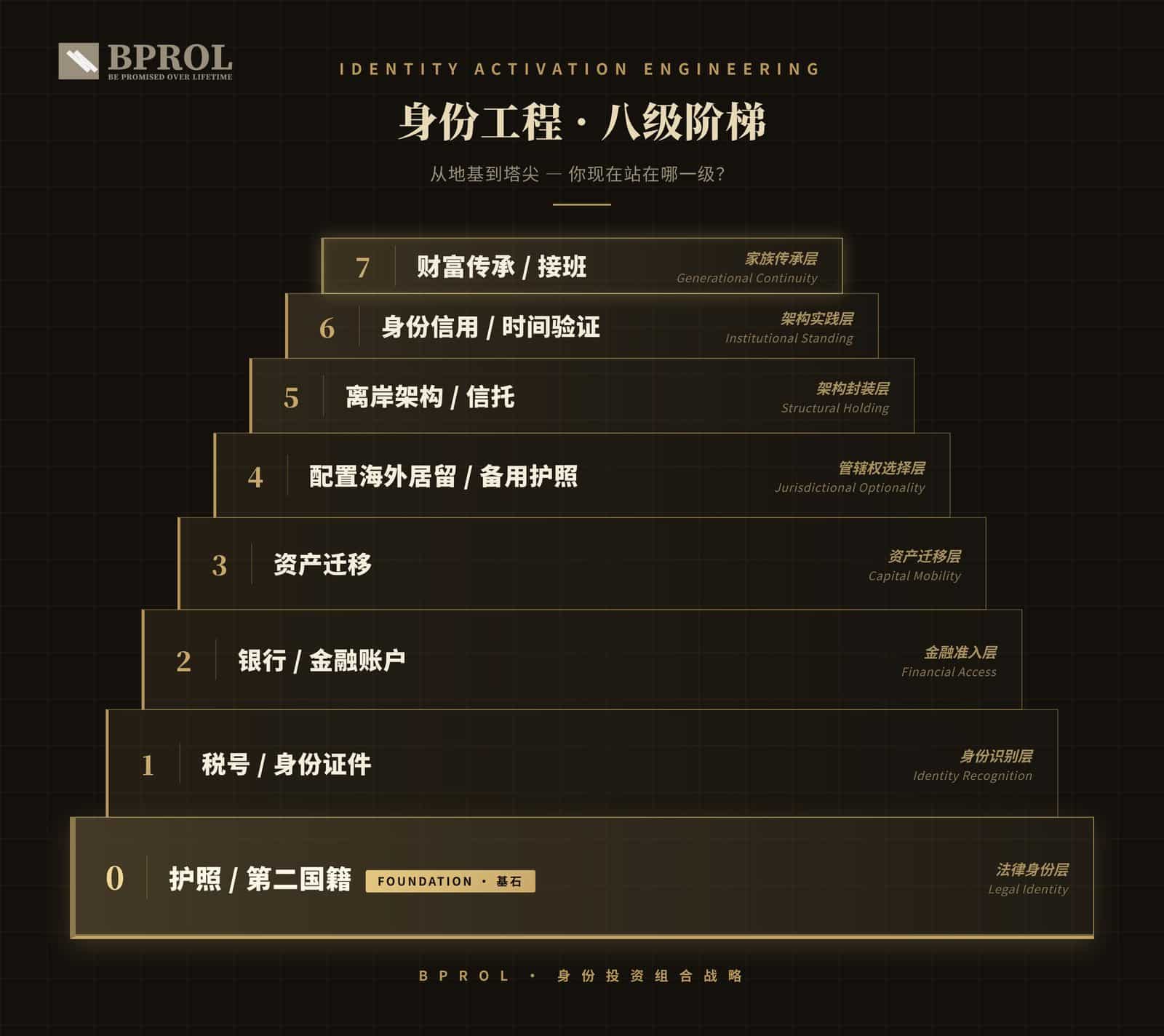
Most people think an overseas identity is a matter of "having" versus "not having." Those who have actually walked this road know that, in the evolution from CRS to CRS 2.0 and then to CARF, a "globally recognized overseas identity" is a staircase from foundation to spire—the passport is only the most basic configuration, and above it layer upon layer must be implemented before the entire "identity structure" can stand firm.
And the reality in 2026 is that automatic information exchange already covers more than 100 jurisdictions. This article is written for those who are already on this road, or who have already taken the first step but have not yet configured their identity into a system.
This article will help you understand 8 levels and four stages of identity: from owning an identity to family succession.
And the "family office" you often hear about will also appear among these 8 levels.
Getting a passport is a new beginning
Let me say what should be said first: making it to the step of getting a second passport is itself a remarkable decision.
This is not a small sum of money, nor a rash choice. You saw through the risk behind a single nationality and, while most people had not yet realized the problem, planned ahead for yourself and your family—so this is genuine progress, and a position many people never reach in their entire lives.
Precisely because this step was taken correctly, it is all the more worth continuing to do it more perfectly; the passport is not the finish line, but a new starting point. However, the legal identity being established is only the first step;
next, we will use a clear ladder of levels to help you see where you currently stand.
Level 0: Legal Identity layer—identity established and used for the first time
What you have at this level: naturalization certificate(Certificate of Naturalization) and a passport, and you have already actually used the passport at least once—for example, completing one entry or exit on the new passport.
Getting a passport means that, in legal terms, you now genuinely have one more identity, one more path, one more possibility. A life once confined to a single country now has a second option—it is the first step in turning a second identity from "not having" into "having."
Level 1: Identity Recognition layer—making the system recognize you
What you have at this level: TIN (tax ID), Proof of Address, and a local Photo ID or driver's license.
What does it take for a legal identity to be recognized by real-world systems? If you hold two passports at the same time, which country do you actually belong to?
For example, you have a Chinese passport and a Caribbean passport, but you also have a Chinese ID card, a Chinese address, and a Chinese tax ID—so which country does the bank believe you belong to? Which country will CRS exchange you to? This is precisely the St. Kitts genuine-link reformand the "genuine link" problem it seeks to solve.
These three documents: a Photo ID (a photo-bearing identity document, such asDominica Driver's License) explains "who you are," the proof of address explains "where you are," and the TIN (tax ID) explains "to whom you owe tax." These three, combined with the nationality on your passport, turn your identity from an abstract concept into a real individual that can be looked up and matched in the databases of administrative and financial systems.
Level 2: Financial Access layer—funds now have a legal entry point
What you have at this level: A bank account, and a securities or crypto-exchange account.
The easiest way to verify the results of Level 0 and Level 1 is that you can open a bank account and be recognized by the financial system. Being able to open an account is what lets you "move money." This level is the first real-world test of all the documents that came before. Because a bank never looks at a single document, but at the combination of your full set of materials: passport, Photo ID (photo-bearing identity document), proof of address, TIN (tax ID), plus a clear explanation of your source of funds. The more complete these configurations and the more they corroborate one another, the more "stable" your identity looks in the bank's eyes. If the materials don't match up (for example, a Caribbean passport + a Southeast Asian tax ID + residency in yet another place), then even if the account is reluctantly opened, it will be full of risk of being knocked down at any time.
At this layer, the second identity becomes truly "usable" for the first time—accounts can be opened, money can flow in, and between you and the overseas financial system there is finally a legal entry point.
Level 3: Capital Mobility layer—assets and money can actually be moved overseas
What you have at this level: Funds, real estate, or assets such as stocks are successfully transferred into the name of the second identity (Capital Mobility).
Completing Level 0 through Level 2 means you have completed the most basic infrastructure of an overseas identity; what Level 3 aims to achieve is that assets and cash truly complete their cross-border migration, land in the financial system of the new identity, and are verified by overseas banks, exchanges, and local financial regulators.
Between opening an account and actually transferring assets over lie foreign exchange controls, source-of-funds scrutiny, and tax settlement in the original tax jurisdiction. An opened account only means you "can receive money"; it does not mean you "can put the money in legally and safely." The real test of Level 3 is not opening a door, but getting a sum of money to pass smoothly through the door without setting off any alarm bells.
Completing Level 3 means your identity is no longer merely "able to open accounts," but is the infrastructure "able to hold assets."
Level 4: Jurisdictional Optionality layer—you can choose "where to live" and "by whom to be governed"
What you have at this level: Residency in a third country (3rd Country Residency), and Plan C nationality (a third passport).
What this level addresses is not "whether the person can leave," but a higher-dimensional question:when the rules conflict, which set applies to you?
For the vast majority of people, their entire lives—wealth, marriage, inheritance, business contracts—are all bound to the laws and tax systems of a single country. The other party knows, the courts know, and the tax authority knows too—all your chips are placed on the same card table. Whenever this system undergoes a policy shift, you can only passively bear it.
After achieving Level 0, you obtain a passport through fast-track naturalization and begin to feel for the first time that "I can choose my nationality," but this runs into two problems: first, will you actually live in this country? Second, are you willing to disclose this passport?
One more residency, one more nationality, is essentially connecting yourself toanother set of judicial and tax jurisdiction. For many people, aCaribbean passport (such as Dominica)is the starting point of this road. What it gives you is not an escape door, buta large country where you can truly live,the right to choose the applicable jurisdiction: your tax resident identity is no longer locked down by a single country, a second passport need not be exposed and can be re-planned on a compliant basis; when cross-border contracts, property division, and equity inheritance involve overlapping jurisdictions—what you hold in hand is multiple sets of legal systems you can invoke and apply.
A passport gives you the right to go; a residency gives you the ability to enter and exit repeatedly, or even to stay long-term; Plan C means that even if one identity runs into trouble, you still have a backup. Reaching this level, you possessCompetition between rule sets,Choosing between rule setsthe protection of.
Here there is a transitional state worth explaining: Level 4 in the strict sense points to formal residency or a third nationality. But in practice, holding a long-term multiple-entry visa from a major country—such as a Japanese multiple-entry visa, or multi-year multiple-entry visas from the UK, US, Canada, etc.—is not equivalent to residency, but in the sense of "whether a person can go and can stay repeatedly," it provides a lightweight form of geographic flexibility that can serve as a transition toward formal residency.
Reaching this point is a watershed: with Level 1 through 4 all assembled—the identity architecture established, the system able to recognize it, and funds able to flow—this is true "identity freedom." At this step, you truly are no longer held entirely in the hand of any single country.
Once your identity, accounts, and assets are all in place, the next question becomes: where will you live, and under whose jurisdiction. This layer determines whether you can truly anchor your life and wealth in a more advantageous place.
Level 5: Structural Holding Layer — putting armor on your assets
What you have at this level: Offshore companies, trusts, investment holding structures, and insurance.
These eight levels are a logical progression, not a strict linear timetable — in practice, Level 4 and Level 5 can often advance in parallel. Structural holding does not necessarily have to wait until residency is secured before it begins.
Once both the people and the money are in place, this level is about putting armor on your assets.
If Level 4 lets you as a person choose whose jurisdiction you fall under, then this level lets your assets gain the same ability—through offshore structures and trusts, assets are placed into a jurisdiction you choose, rather than one defaulted by your place of birth. From then on, the rules governing your assets are the ones you pick, not the ones birth decided.
Bare-held assets are exposed to the multiple risks of taxation, litigation, inheritance, and privacy. Upgrading assets from "individual bare holding" to "structured holding"—using companies, trusts, and insurance to isolate, optimize, and protect wealth—is what truly preserves it. This is the leap from "owning wealth" to "controlling wealth."
Level 6: Institutional Standing Layer — validated against your real, everyday habits
What you have at this level: The rules between your second identity and your original nationality have been re-established, and confirmed through your personal practice and over time.
The keyword at this level is not "built," but "validated" and "able to withstand time."
Building the structure and getting the processes running is only an establishment on paper. A second identity that truly holds up is not something you "buy" with money, but something "cultivated" over time.
No country's system will instantly fully trust a new identity with no trace of life. You need to let it grow a "track record" in reality: the residence card has been renewed once as a matter of course, the tax ID has passed smoothly through one or two reporting cycles, the account has remained normal in continuous use, and the structure has undergone one real compliance review. These steps have one thing in common—None of them can be sped up with money; they can only accumulate over time, be validated and recognized by multiple institutions. Going through one complete cycle like this typically takes two to five years.
This is also why the logic of this matter naturally leans toward "starting early": the credibility of an identity is a curve over time,the earlier you begin, the sooner the curve climbs to the height you need it to reach. It is unlike insurance — which pays out the moment a loss occurs; it is more like transplanting a tree, which must be planted early, rather than waiting until the day you need the shade to begin.
Level 7: Generational Continuity Layer — passing the system on to the next generation
What you have at this level: Your children's inheritance of identity and second-generation passport planning, trust beneficiary structures,Family Officesor succession arrangements.
Once the closed loop at the individual level is achieved, the endgame at the family level truly begins—the real endpoint is the next generation. The whole identity and asset system built up over the previous seven levels begins, here, to work for the children: locking in identity for the next generation, passing down wealth, and arranging succession. This system no longer serves you alone, but continues across generations.
This is often the ultimate motivation for high-net-worth families doing all of this — not for themselves, but for their descendants. Only when an identity system can be smoothly passed on to the next generation does it truly transform from "one person's escape route" into "a family's foundation."
Which level are you on right now?
For most people, reaching Level 4 already achieves complete identity freedom; Levels 5 through 7 are advanced configurations for those with family wealth succession needs. You don't have to go all the way at once—first clarify your stage goals, fill in level by level, and you are already heading in the right direction.
Strung together along a single line, these eight things form a clear identity-system ladder:
- Level 0 Legal Identity Layer: certificate of naturalization + passport, and actually used once
*At this point, the first cornerstone is set, and your "backup life" is officially underway.*
- Level 1 Identity Recognition Layer: TIN + proof of address + Photo ID
- Level 2 Financial Access Layer: bank account + exchange account
- Level 3 Asset Migration Layer: assets transferred under the second identity
- Level 4 Jurisdiction Selection Layer: third-country residency + Plan C citizenship
*Reaching this point is a watershed: with Level 1 through 4 all assembled—the identity architecture established, the system able to recognize it, and funds able to flow—this is true "identity freedom." At this step, you truly are no longer held entirely in the hand of any single country.*
- Level 5 Structural Holding Layer: offshore company / trust / investment holding structure / insurance
- Level 6 Institutional Standing Layer: identity separation achieved, and validated through real-world testing against your personal habits
- Level 7 Generational Continuity Layer: children's inheritance of identity + trust beneficiary structure + family office / succession arrangements
Understand this through-line in one sentence:
> Legal identity (0) → recognized by the system (1) → money has an entry point (2) → assets truly migrate (3) → able to choose whose jurisdiction (4) → assets put on armor (5) → structure validated in practice (6) → passed to the next generation (7).
Most people who have just obtained a passport are standing at Level 0 or Level 1 at this moment. There is nothing wrong with that at all—this is precisely where "identity engineering" has just begun. What matters is not which level you are at now, but whether you clearly know what your goal is and whether you want to move to the next level. What does the next level require you to fill in, and—before the day you truly need it arrives—filling it in level by level.
The passport is the starting point; activation is the engineering
Back to that opening line: true wealth is how much you have that cannot be taken away unilaterally.
By obtaining a second nationality, you have already completed the hardest and most critical step—one most people never reach in their entire lives. It is not just a passport, but a starting point already in hand: you have connected yourself to the gateway of freedom, you can go to more visa-free countries and travel more freely to new destinations; what remains is to let this identity slowly grow solid in reality.
And letting it grow solid relies on correct planning and the accumulation of time. Because the system will not fully trust a new identity with no track record—it wants to see how many times you've used it, whether your tax ID has passed smoothly through several cycles, whether the account stays normal in daily life, and where you live overseas. These "identity engineering" tasks all require the right steps and the accumulation of time. It is more like a car: you don't need to drive 100 kilometers today, but you should start it occasionally, do maintenance early, and make the necessary configurations, so that when the day you truly need it arrives, it is already stable enough for the family to ride in and to take you where you want to go.
So how do you activate a second passport? The real difficulty of this lies first in direction, and then in "the accumulation of time" — the earlier you let the passport begin to build a real track record, the sooner it can be activated and become an identity you can truly call upon at the critical moment.
If you have already obtained your passport but are unsure which level you currently stand on or what to do next, we welcome you to get in touch. We can discuss it with you, help you clarify the various paths and programs, and plan the configuration best suited to your family.
True freedom is not being able to go anywhere, but having the right to choose — no matter which side the storm comes from — to choose the rules that favor you, and to choose your way out.
-
WeChat: bih2005 | Telegram: bih2005 | Email: [email protected]
If you found this article helpful, please share it with friends who need it.
To learn more about identity planning and global asset positioning, you can speak withContact UsThe
YouTube Channel
Wechat:bih2005
WhatsApp:+306948236794
WhatsApp:+442081449188
Telegram (bih2005)
Email. [email protected], [email protected]
Further Reading


comparisons
Bih Channel
Click hereBook a VIP Consultation
Dominica Citizenship by Investment Program
- Established in 1993, the Dominica Citizenship by Investment Program is one of the oldest such programs in the world.
- Passport ImmigrationNo interview is required of applicants
- Immigration can be processed quickly, in approximately 2 to 3 months.
- The most cost-effective program for single applicants
- Citizenship can be passed down permanently to future generations in the direct line.
- Book a Consultationreserve