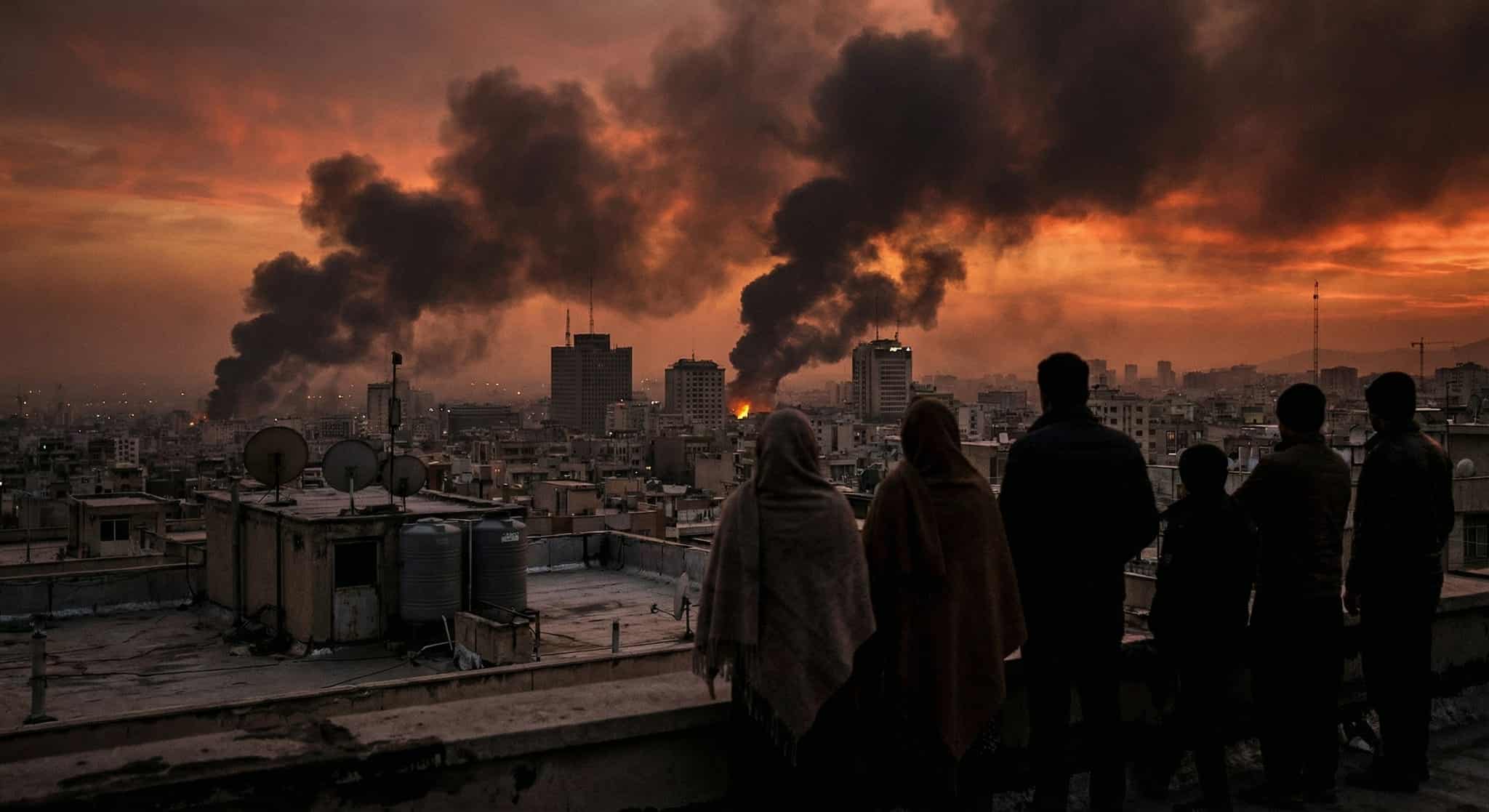
Khamenei confirmed killed in action — Israeli airstrike on 2/28, confirmed by Iranian state television in the early hours of 3/1. Trump announced it first on Truth Social.
Military command nearly wiped out — General Mousavi, Defense Minister Nasirzadeh, IRGC Commander-in-Chief Pakpour, and Shamkhani all killed.
Israel launches a second wave of airstrikes on Tehran on 3/1 — aiming for air dominance over Tehran. The CIA assisted with targeting (NYT report).
Iran's capacity to retaliate is limited — fired missiles at Beit Shemesh in Israel (17 injured); struck Abu Dhabi airport (1 dead, 7 injured). The Israeli military says it destroyed about half of Iran's missile stockpile back in June 2025.
Strait of Hormuz effectively blockaded — the IRGC prohibited vessels from passing via VHF broadcasts, and tankers rerouted en masse.
US consulate in Karachi, Pakistan — Shia demonstrators breached the perimeter wall, 9 dead. Demonstrations broke out simultaneously in Iraq.
Civilian casualties — a girls' primary school in Minab, southern Iran, was hit in an airstrike, 108 dead (Guardian report).
The power vacuum enters its filling phase — Iran appointed Alireza Arafi to the leadership council, with the legitimacy of the succession in question.
Twenty million barrels of crude oil pass through the Strait of Hormuz every day, accounting for 20% of global demand. Today, this chokepoint of the global economy has been completely tightened.
The United States and Israel launched joint military strikes against Iran; Tehran was rocked by explosions, and Iran has fired retaliatory missiles at northern Israel and U.S. Gulf bases. Oil prices are reported to have broken past US$72, and gold is reported to be up 22% year-to-date. This is not a drill, not a simulation—this is the biggest geopolitical black swan of 2026.
If any part of your asset allocation is tied to the Chinese banking system, the U.S.-dollar clearing channel, or Middle East trade chains—the shockwave is already on its way. If you hold only one passport—your identity, assets, and freedom are all tied to the decisions of a single government.
This article does not discuss the course of the war; it answers only one question:The US-Iran war's impact on Chinese investors has already begun—under the latest 2026 situation for identity planning, what should you do now?
I. How does this war directly affect China's high-net-worth individuals?
1. The Spillover Effect of Secondary Sanctions
Iran is China's largest source of sanctioned oil. US military action against Iran will inevitably be accompanied by an escalation of harsher financial sanctions—and the logic of secondary sanctions has never been to "hit only Iran," but to "hit every entity that does business with Iran."
The risk facing Chinese banks is not hypothetical but an unfolding reality: the U.S.-dollar clearing channel could be cut off at any moment. In 2025, the United States already imposed a new round of sanctions on more than 30 Iran-related entities, and in a state of war, this list will only grow longer, faster, and more uncompromising.
Core question: does your funding channel depend on a single US-dollar clearing system? If the answer is ”yes,” your asset liquidity is already within range.
⚡ Escalation Warning: This War Is Not Just "More Sanctions"
The old sanctions logic was to use economic pressure to force the other side to compromise. But after February 28, 2026, the rules of the game have changed—this is a targeted elimination operation aimed at "decapitation + regime change." The supreme leader, the military command tier, and the core decision-making network were almost entirely wiped out within 72 hours.
The path of impact therefore becomes shorter, faster, and more unpredictable. Sanctions take weeks to transmit to financial markets; but a power vacuum can leave the Strait of Hormuz in a command-less state within hours.
The 2011 Libya war is the most recent reference point. After the collapse of the Gaddafi regime, Chinese enterprises' investment losses in Libya exceeded 20 billion US dollars—not because they were sanctioned, but because their contractual counterparties vanished, engineering projects had no one to take them over, and funds had nowhere to be recovered. This time, Iran's scale is more than ten times that of Libya, and its depth of linkage to the Chinese economy is incomparably greater.
With sanctions, you still have time to respond; with regime change, the shock wave arrives before you can react.
2. The Acceleration of the "Weaponization" of the Dollar System
Sanctions are no longer merely a policy tool, but a means of warfare. The US-Iran conflict has made one thing clear to the world: the dollar system can, within 24 hours, sever any country or entity from the international financial network.
This sanctions template can be replicated at any time—used on Iran today, it can be aimed tomorrow at any "hostile" or "non-cooperative" entity. For business owners and investors operating between the Chinese and U.S. economies, this is not a geopolitical topic but a question of survival.
Escalation timeline: On February 6 the Muscat talks broke down; on February 16 military exercises took place in the Strait of Hormuz; on February 25 the U.S. imposed new sanctions on more than 30 entities; on February 26 the U.S. demanded Iran destroy its nuclear facilities, which it refused; on February 28 fighting began. Each step seemed remote at the time, but every step pointed to the same endpoint. The sanctions infrastructure is already built; all that remains is to expand the scope of the strikes.
3. KYC Piercing and Passport Color—The 2022 Script Is Being Replayed
In a state of war, the compliance reviews of banks worldwide tighten immediately. KYC no longer looks only at the source of funds, but also at passport color, tax-residency status, and whether fund pathways pass through sanctioned regions.
In 2022, within 72 hours of the outbreak of the Russia-Ukraine war, the bank accounts of individuals and entities holding Russian passports were frozen on a massive scale—no proof of any connection to the war was required, only that the color of your passport was "wrong." From the announcement of the policy to the freezing of accounts often took only days, or even hours. By the time you reacted, the funds could no longer be moved out. This is no alarmism. This is a fact already verified in 2022.
Now the same script is being replayed on Iran. And this time, the scope is broader.
Iran is an important source of sanctioned oil for China. The United States has already exerted clear pressure, demanding that China stop purchasing Iranian oil. Chinese banks that deal with Iran are facing the risk of being cut off from SWIFT. If all your assets are concentrated in a single jurisdiction, and your bank account is bound to a single identity, then the only difference between you and a frozen Russian oligarch is one of scale.
A Chinese passport already faces growing restrictions on opening bank accounts even in peacetime. In an environment of escalating war and expanding sanctions, these restrictions will only become stricter and more unpredictable. No direct business relationship with Iran is needed at all—if any single node in your funding chain touches a sanctioned entity, the compliance system may flag you as high-risk.
II. Within the Closed Loop of the Three Networks, Traditional Hedging Methods Have Failed
Many people's first reaction is: buy gold, shift to crypto assets, move the money to a "safe place." These methods may have worked in 2015, but in 2026, with CRS 2.0 fully underway, the regulatory net has full coverage, and not a single channel is safe.
CRS (Common Reporting Standard): information on financial accounts opened in any country is automatically exchanged back to the account holder's place of tax residency; since its 2018 launch, it has covered over 100 countries and regions.
IPI MCAA (automatic exchange of real-property information): effective in 2025, overseas property is no longer a gray-area safe haven; properties purchased in Dubai, Bangkok, and London are crystal clear to the tax authorities.
CARF (Crypto-Asset Reporting Framework): formally effective on January 1, 2026, implemented by an initial 48 countries; crypto wallets, exchange accounts, and stablecoin holdings—all brought into cross-border automatic reporting, with cross-border data exchange starting in 2027.
CRS + IPI MCAA + CARF = a three-network closed loop—financial accounts, real estate, and crypto assets—with all three escape routes completely sealed off. The traditional offshore structure is not protection but a precisely drawn target. Using tactical cleverness to fight against a strategic-level trend, the outcome was written from the very start.
What is the only dimension not yet brought into automatic exchange?Identity itself—legal personality, tax-residency status, passport. This is the real battlefield for overseas asset protection in 2026.
III. Action Checklist: Three Things to Do Now
Step One: Establish a "Foundational Identity"—Structural Isolation at the Level of Legal Personality
exist CARF era, the underlying logic of asset protection has shifted from "where to hide your money" to "under what identity you hold these assets."
Optimize your foundational identity tool. Holding a second passport (a complete second citizenship) is not about the visa-free count, but about strengthening your own legal hardness within the global financial system—preventing your overseas freedom and asset flexibility from being implicated when, by holding a single nationality, your original nationality comes under sanction.
On optimizing your tax architecture, in the CRS 2.0 era, you need not only an overseas identity that is exempt from worldwide taxation and free of capital gains tax, inheritance tax, and gift tax, but also one that can more legitimately integrate into the global financial system and hold up within a compliance framework.
structural isolation at the level of legal personality,The value of a passport is revealed not in peacetime but in moments of crisis. The value of an extra identity is structural isolation at the level of legal personality—the "ultimate line of defense" able to stand to the very last under sanctions, CRS 2.0, and CARF penetration.
Step Two: Launch Your Identity Architecture—The Second-Passport Application Process and a Multi-Jurisdiction Combination
An overseas passport is the foundational identity, but a complete identity architecture requires multiple layers:
Foundation layer (identity layer)::Dominica Passport → legal-personality isolation, access to the global financial system, opening offshore bank accounts, and holding crypto assets without triggering automatic flagging.
Middle layer (residency layer): apply for residency in Japan, Australia, or the EU → a base for actual living and business operations.
Upper layer (tax layer): based on your actual place of residence and business structure, establish a tax-residency status that can withstand CRS + CARF piercing scrutiny.
Core logic:Identity is not a fixed attribute determined by birthplace, but an infrastructure that can be actively constructed, and its structural functions—financial freedom, asset protection, optionality—remain continuously effective under any political environment.
Step Three: Launch the "72-Hour Action Checklist"
When sanctions land, the window left for you is measured in hours. You need to prepare a contingency plan that can be executed immediately, right now:
Confirm the activation status of your second-country passport (whether it's full citizenship, whether it has more than 6 months of validity)
Ensure you have a compliant offshore bank account
Have a Tax Residency Certificate (TRC) ready, or hold legal residency in a third country
Don't wait until the day the sanctions list is published to discover that your "Plan B" was never truly activated.
IV. Why Now?
The cost of citizenship by investment will only keep rising, never falling. The Caribbean citizenship threshold has already climbed from US$100,000 to US$200,000, an increase of 100%. The era of acquiring quality citizenship through low-cost investment will become history; this window will not stay open forever.
Smart investors do not wait until their own name appears on a sanctions list to start acting; instead, they position themselves in advance to ensure they always hold the initiative over the future.
A leaderless Iran is more dangerous than a led Iran
Many people mistakenly assume: with the Supreme Leader dead, the Iranian threat is removed and the risk is lower. This judgment is wrong.
Iraq in 2003 is the clearest lesson. After the fall of Saddam's regime, Iraq did not become safe—it became unpredictable. Armed factions of every stripe scrambled for the power vacuum, proxy networks lost central command, and the situation evolved from a "concentrated, controllable threat" into "dispersed, randomly erupting violence." Foreign capital withdrew, contracts were broken off, insurers stopped underwriting, and the entire region's business logic was completely rewritten within 18 months.
Iran today commands a far larger proxy network than Iraq did in 2003: Lebanon's Hezbollah, Yemen's Houthis, Iraqi Shiite militias, and forces stationed in Syria. After losing Tehran's command, these armed groups will not automatically disband—they will each fight on their own, on their own battlefields, acting according to their own logic.
Regional risk shifts from "concentrated and predictable" to "dispersed and uncontrollable." The impact of this on supply chains, shipping insurance, and cross-border fund flows will be far harder to hedge than a bounded interstate war.
Saddam's fall was Day 1. Iraq truly descended into chaos only after Day 3.
And right now, it is Day 3.
Three questions you should ask yourself now
If your main bank account were frozen tomorrow, do you have a backup funding channel independent of your existing financial system?
If your travel were restricted or your passport's use were limited, is there a second legal identity you could invoke?
If CARF launches cross-border data exchange in 2027, can your asset-holding structure withstand piercing scrutiny?
If the answer to any of the three questions is "uncertain"—what's needed is not wait-and-see but action. How to avoid sanctions risk, the optimal path for overseas asset protection in 2026, the second-passport application process—the answers to these questions will not appear only when you are ready.